
A logistics company in Business Bay called us on a Wednesday needing their entire floor moved to a new tower by Monday morning, desks, servers, filing cabinets, a full reception setup, the works. Their previous plan, using their own staff and a rented van over a weekend, had fallen apart once someone actually counted how many desks were involved. We sent a full crew in Friday evening, worked through the night, and their team walked into a fully set up office Monday at 9am like nothing had happened. That’s really the whole job with office moves, not just moving furniture, but making sure a business doesn’t lose money sitting idle.
Why office moves are a different kind of job
A house move is stressful for a family. An office move is stressful for a business, and the stakes are different. Every hour a company spends unable to work is an hour of lost productivity, missed calls, delayed projects. That’s why office relocations get planned around time in a way that home moves usually don’t. The furniture matters, but the clock matters more.
There’s also teamwork needed than people think when they start. IT gear has to be disconnected and connected again the way not just unplugged and put in a box. File systems, those with client information or agreements must stay neat so nothing gets misplaced or mixed up between teams.. There’s usually a lot of talking with the building managers on both sides about things like access, to the loading area using the service elevator and sometimes a certificate of insurance the building asks for before allowing a moving team to come in.
Why we move offices overnight or on weekends
Most businesses can’t afford to shut down for a day while a move happens, so the bulk of our office relocations happen outside working hours, Friday evening through Sunday, or overnight during the week for smaller offices. The idea is simple. Staff leave the office on Friday at their old desk, and by Monday morning everything, computers, files, even the desk plant if someone insists on bringing it, is set up at the new location exactly where it needs to be.
This isn’t always possible for every business, some need a phased move over a few days if the office is large enough that a full weekend turnaround isn’t realistic. Either way, the goal is the same, minimize the number of working hours a business actually loses.
How pricing works for an office move
Office move pricing usually comes down to three things, how much is being moved, how far, and how much of it needs specialized handling. A small office with a dozen desks and some filing cabinets costs a lot less than a full floor with a server room, dozens of workstations, and a reception area to rebuild. Distance matters too, though usually less than volume and complexity.
We quote based on either a site visit or a detailed video walkthrough of the current office, whichever works better with your schedule, since we know business owners are often juggling this alongside actually running the company. From that we can give a fixed number covering packing, IT disconnection and reconnection, transport, and setup at the new location, so there’s no guessing involved once the move is underway.
What actually gets included in an office moving quote
This varies more between moving companies than people expect, and it’s worth checking carefully before comparing prices. A basic quote usually covers loading, transport, and unloading. What sometimes gets left out, and then shows up as an added cost later, includes IT equipment handling (properly labeling and protecting servers, monitors, and cabling so reconnection is straightforward), furniture disassembly for anything modular like cubicle partitions or large conference tables, and setup at the new office, meaning desks and equipment actually placed where they belong rather than just dropped in the lobby.
Worth asking directly whether IT handling and full setup are included in the base price, or if they’re separate add-ons. A quote that looks cheap on paper sometimes turns into a longer, more expensive day if half the job wasn’t actually priced in.

Handling IT equipment and sensitive files properly
This is where office moves differ most from a home relocation. Servers, networking equipment, and computers need to be disconnected in a way that makes reconnecting them straightforward, cables labeled, connections photographed before disassembly if the setup is complex. We don’t touch the actual network configuration, that’s for your IT team or provider, but the physical handling and transport needs to be careful enough that nothing gets damaged or lost in the shuffle.
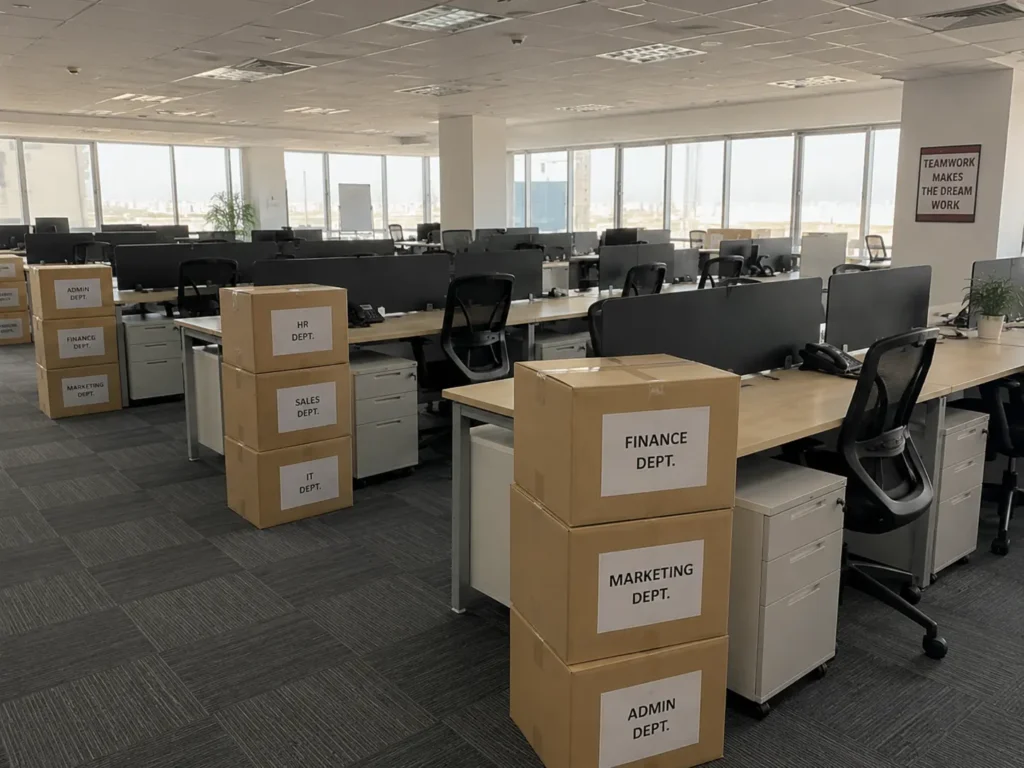
Filing cabinets with client contracts, HR records, or financial documents get treated with the same care, kept sealed and labeled by department rather than mixed together in generic boxes. For anything particularly sensitive, we’re happy to have your own staff oversee that specific part of the packing if it gives you peace of mind, it’s your business, and we’d rather build trust than ask you to just take our word for it.
Coordinating with building management, both ends
Almost every commercial building in Dubai has its own rules about moves, and this is often the part that trips businesses up if they haven’t done it before. Loading docks usually need to be booked in advance, sometimes with a specific time window. Service elevators usually need something from the moving company before they will let them use the elevator. This something can be a deposit or a certificate of insurance. Some buildings only let people move in or out at times. They do this so they do not bother the people who live or work there when they are supposed to be working.

We talk to the people in charge of the building at the place and the new place. We make sure we know when we can use the elevator. We book it so it is ready when we need it. We also get all the paperwork done that the building needs. We do all this before the moving truck gets there so everything is ready. There are no surprises that can slow us down on the day of the move. We handle all this for the service elevators, at both the address and the new address.
What to sort out on the admin side before you move
A few things are worth handling on your end in the weeks before the move, separate from the physical relocation itself. Your DEWA business account needs updating for the new address, along with final meter readings at the old location. If your Ejari or commercial tenancy contract needs registering for the new office, that’s worth starting early since it can take a few days to process. Your trade license address also needs updating with the relevant authority, since an outdated address on your license can cause issues with banks, clients, or government paperwork down the line.
It’s also worth giving your internet and phone provider, Etisalat or du, enough notice to have connectivity ready at the new office before moving day, rather than finding out on Monday morning that the internet installation is still a week out. None of this is something we manage directly, but it’s worth having on your own checklist a few weeks ahead rather than remembering it the week of the move.
Timing your move around the business calendar
Ramadan and the weeks around major public holidays, Eid, New Year, tend to be quieter for office relocations since a lot of businesses prefer not to disrupt operations during those periods. If your move date is flexible, scheduling outside these windows usually means easier availability and a smoother coordination with building management on both ends, since they’re not juggling multiple tenant moves at once.
The end of the quarter and the end of the year are also times when businesses usually move to a new place. This often happens when the lease is up for renewal. If this is what is happening with your business it is an idea to book a moving company a few weeks before you have to be out of your old office. Do not wait until the week before your lease is over because this is usually the time for office movers, in the whole city.
Choosing an office mover that you can really trust
For a home move, if something small gets scratched, it’s frustrating. For an office move, if a server gets mishandled or client files go missing, it’s a real business problem. A few things are worth checking before you book a company for an office relocation specifically. Do they carry insurance that actually covers commercial equipment, not just general liability. Have they handled office moves of a similar size before, not just residential jobs. And are they willing to provide a written quote breaking down what’s included, rather than a vague verbal number.
It’s also worth asking how they handle confidentiality for sensitive documents, since a legitimate company should have no issue answering this directly. If a mover seems evasive about insurance or experience with commercial moves specifically, that’s worth taking seriously before handing over your entire office’s equipment and records.
What moving day actually looks like
For a weekend office move the team usually shows up on Friday night after employees have gone home for the day. The first thing they do is take and label the IT equipment because that is usually the most important and needs the most attention. Then they take apart the furniture if it is the kind that can be taken apart. All the things are packed up moved to the place and then put back where they belong. The furniture and equipment go where they are supposed to based on a plan that was made ahead of time of trying to figure it out when they get there.
By the end of Sunday or Monday morning the goal is to have the whole office working again. Desks are, in the places the IT is connected so that the companys own IT team can finish setting up the network and everything is labeled so that employees can find their things without having to look everywhere on their first day back.
What people usually ask before they book the move
The common question is whether the move can really happen without any problems with work hours. For offices the answer is yes that is the whole idea of planning the move during the night or, on a weekend. Big offices sometimes have to do it in parts over a days if doing it all in one night is not possible and we will say that clearly when giving a quote instead of promising something we can’t do.
People also ask about liability if equipment is damaged during the move. With proper insurance in place, there’s a clear process for this, documented, reported, and addressed, rather than an argument about whose fault it was. It’s one of the reasons checking a mover’s insurance coverage matters more for a commercial move than it might for a smaller residential job.
Another common question, can a move be done in phases if not everything is ready to go at once, say if some departments are moving before others. This is usually manageable, and worth discussing during the quote so the schedule accounts for it properly rather than assuming everything moves in a single trip.
Not a business move? Here’s what else we handle
Movers and Packers Dubai Services

Villa Movers and Packers in Dubai
If you’re relocating a larger residential property with multiple floors and outdoor furniture, our villa moving page covers how we handle that specific scale of home move.

House Movers and Packers in Dubai
For a full family home rather than a business or villa, our house moving page goes into the packing and coordination involved in that kind of relocation.

Local Movers and Packers in Dubai
For a shorter residential move across the city, our local moving service is built around quicker turnarounds without the scale of a full villa or house job.